Who is being left behind? Part 6: What is the influence of education?
Background:
In the RRC’s study, “Who Is Being Left Behind,” over 2,000 workers were surveyed related to their balance sheet, financial wellness, and financial health.As shown in previous Research Minutes, four distinct segments were found in the study including: Thriving (10%), Getting Along (30%), Optimistic with Debt (7%), and Struggling (52%). In this week’s analysis, we assess the intersection of ethnicity and education.
Findings:
Higher education has long been considered a driver of increased financial security, albeit with some recent skepticism about this return on investment given the impact of student loan debt. When taking a closer look at the intersection of ethnicity and education levels in this study, we found that Black and Hispanic workers remain more likely to reside in the Struggling segment across all levels. Moreover, the gap separating them from white workers is larger for those with a college degree or greater.
When analyzing those with the highest levels of education, white workers are disproportionately more likely to reside in the Thriving segment, which represents those who are more financially well-situated. Conversely, as the chart below illustrates, in the Struggling segment–even with high education levels–Black and Hispanic workers are more likely to be in the Struggling group as compared to white workers.
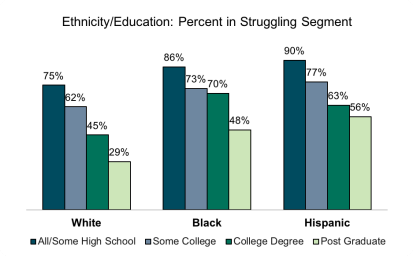
Please note, the “postgraduate education” category includes some study at that level and/or completion.
Bottom line:
As we have highlighted in past Research Minutes on this study, the disparity in overall financial health across ethnicity holds by age, gender, marital status, and income, and this Research Minute illustrates that this persistent gap holds across education levels as well. Education is perceived to be an “equalizer,” yet the disparities in financial health among various races at high education levels illustrates that the gap remains.