Who is being left behind? Part 5: Is it about income levels?
Background:
In the RRC’s study, “Who Is Being Left Behind,” over 2,000 workers were surveyed related to their balance sheet, financial wellness, and financial health.As shown in previous Research Minutes, four distinct segments were found in the study including: Thriving (10%), Getting Along (30%), Optimistic with Debt (7%), and Struggling (52%). In this week’s analysis, we assess ethnicity and income.
Findings:
Income is considered one of the primary drivers of financial disparity. The majority of workers earning less than $50,000 per year are in the Struggling segment, with Black and Hispanic workers slightly more likely to fall into this group.As income levels increase, more marked differences emerge. Across those earning between $75,000-$100,000 per year, only 40% of white workers reside in the Struggling segment, as compared to 56% of Black and 70% of Hispanic workers.
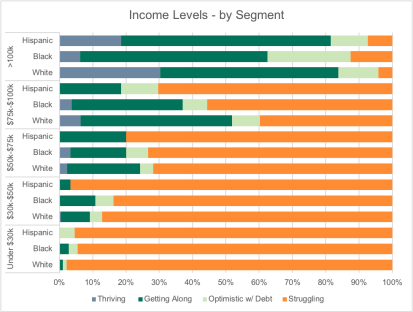
For those earning over $100,000 per year, 30% of white workers reside in the Thriving group, which is the most financially secure segment. However, at the same income level, only 6% of Black and 19% of Hispanic workers are in this segment.
Bottom line:
As we have highlighted in past Research Minutes on this study, the disparity across ethnicity holds by age, gender and marital status, and this Research Minute illustrates that this persistent gap holds across income levels as well.