Who is being left behind? Part 4: The impact of marital status
Background:
In the RRC’s study, “Who Is Being Left Behind,” over 2,000 workers were surveyed related to their balance sheet, financial wellness, and financial health.As shown in previous Research Minutes, four distinct segments were found in the study including: Thriving (10%), Getting Along (30%), Optimistic with Debt (7%), and Struggling (52%). These segments were analyzed across race and gender last week.
In this week’s Research Minute, we follow up on points discussed at the DCIIA Academic Forum on November 15th by looking at the intersection of marital status and ethnicity.
Findings:
Married (or partnered) individuals are generally in relatively better financial positions than unmarried/unpartnered individuals due to a variety of factors. Overall, married (partnered) individuals are much less likely to reside in the Struggling segment. As illustrated below, through a diversity and equity lens, the unmarried group shows a gap between the white population versus Black and Hispanic populations.
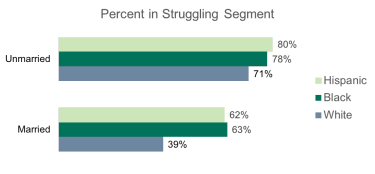
However, these differences are marked across the married groups—where a much higher proportion of Black and Hispanic workers still reside in the Struggling group regardless of marital status.
Bottom line:
Large and pervasive gaps remain when data is analyzed by ethnicity, including by gender and the confluence of marital status. We will continue this exploration in the coming weeks, including a peek into salary and education.