Who is being left behind? Part 2: A focus on ethnicity and gender
Background:
In the RRC’s study, “Who Is Being Left Behind,” 2,004 workers ages 21 to 75 were surveyed. They were asked about various financial topics related to their long term and short-term assets, as well as debt, financial wellness, and financial health questions.
As illustrated in last week’s Research Minute, four distinct segments were found in the study, including: Thriving (10%), Getting Along (30%), Optimistic with Debt (7%), and Struggling (52%). These segments varied by their long-term assets, short-term assets, and debt levels. They were further analyzed by race and gender to find nuances in diversity and equity.
Findings:
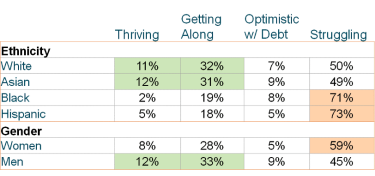
It is notable that just over half of all workers fall into the Struggling group. However, when dissected by ethnicity and gender, we found that the Struggling segment is much more heavily represented by Black (71%) and Hispanic (73%) workers as compared to white and Asian workers. The latter are relatively more likely to make up the Thriving and Getting Along groups. Further, women comprised significantly more of the Struggling segment than men (59% v. 45%).
Bottom line:
Slightly more than half of all ethnicities surveyed land in the Struggling segment, a discouraging finding that indicates precarious financial situations for many individuals. However, there is an even greater disparity among Black and Hispanic workers, who are worse off as compared other ethnicities. The next Research Minute will focus on the intersection of these variables (ethnicity and gender).