Which financial wellness tools and services are most desired by workers?
This Research Minute is the second in a series related to financial wellness.
Background:
Last week, we explored employees’ perceptions around their employer's role and their level of trust in receiving support related to financial wellness. This week, we reviewed which topics are most compelling to workers and the variation across generational cohorts. This research is based on an employee survey assessing financial wellness perspectives across 2,500 workers. The survey reviewed their current level of financial wellness, as well as the role of the employer in supporting their workforce.
Findings:
Employees express diverse financial wellness preferences. To prioritize these, employees were asked to select their top three topics of interest, as seen in the table below.*
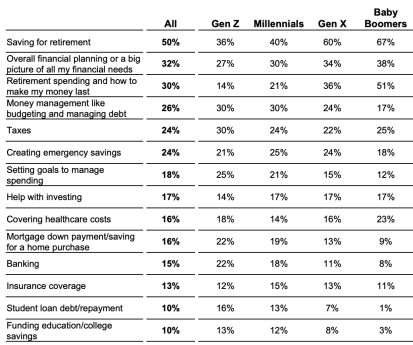
*Note, these responses total to approximately 300%, given each worker voted three times on their selections. There are modest differences due to rounding error.
Saving for retirement was viewed as the most important topic, with over half of respondents including it in their top preferences. This greatly increases with age, as those generations that are closer to retirement – Generation X and Baby Boomers – indicate the highest interest.
Women were more likely to select broad financial planning support, with a total of 35% of women indicating this as a top priority as compared to 30% of men. Women placed a higher priority on retirement spending and making their money last, with 32% of women versus 27% of men.
Following retirement, the top subjects of interest included support for overall financial planning, spending in retirement, and basic money management. Money management was viewed as more pressing by younger generations, whereas retirement spending was top-of-mind for older workers.
Younger generations also prioritized:
- Creating emergency savings and setting goals to help them manage their spending, as well as corresponding savings
- Mortgage down payment and saving for a home
- Student loan debt repayment as well as funding education and college savings
Bottom Line:
These findings highlight the multifaceted role employers must play in supporting their workforce’s financial wellness across multiple generations of employees. As solutions are explored, it is evident that employees have diverse needs, requiring an evolving array of tools and support for a heterogenous workforce.