What insights do our employee focus groups provide about financial wellness?
Background:
As part of a joint RRC and AARP financial wellness study, the RRC conducted a series of diverse focus groups across low- to moderate-income (LMI) workers ages 25-64 that participate in a workplace defined contribution retirement plan. These focus groups were diverse by gender, age and ethnicity and they aimed to gain deeper understanding of workers' perceptions of workplace financial wellness programs. This week's Research minute, part one of a two-part series, centers around key insights related to definitions of financial wellness, interest in engagement, and greatest need and/or topics of interest.
Findings:
Across all focus groups, participants provided definitions of financial wellness, but these were often inaccurate to some degree or confused with workplace retirement plans. This confusion persisted even after they were shown a correct definition of financial wellness. Predictably, participants expressed interest in workplace financial wellness programs that were free, practical, relevant, and unbiased, with some participants expressing interest in programs administered by third parties. Group consensus showed that if employees were provided practical and relevant financial wellness resources, they would be more likely to engage in these programs.
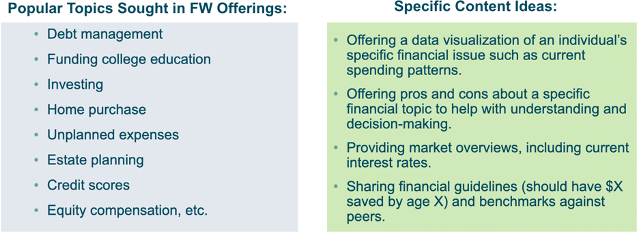
The greatest areas of need, as highlighted in the chart below, ranged from acute to long-term, including debt management, investing, and home purchases. Content ideas included balanced guidance on pros and cons about a specific financial topic to help guide decision-making and providing market overviews. Benchmarks against peers were also cited.
Bottom line:
Our findings reveal that while focus group participants expressed an interest in employer-sponsored financial wellness programs, they lack a clear understanding of what these programs entail and are unfamiliar with common financial wellness terminology. Further, their areas of greatest need and interest extend beyond most traditional workplace financial wellness offerings, encompassing a wide range of financial issues, including estate planning, credit scores, investing, and equity compensation. Participants shared innovative content ideas that could help build out more robust workplace financial wellness offerings.