
This is some text inside of a div block.

What do windfalls tell us about personal financial wellness: are there differences by gender?

Published on
September 20, 2023

This is part two of a series on financial wellness decision-making.

Background: The RRC launched the study, “Examining Employees’ Perceptions of Their Next Best Dollar” to better understand the intersection of financial knowledge, engagement, and influences on optimal financial outcomes for workers.

The RRC fielded an in-depth, 2,500-employee survey in February 2023 to assess their financial wellness and related topics. Survey respondents participated in a simulation exercise where they were asked to spend a financial windfall equivalent to one month’s household wages. They were asked to allocate these windfall dollars across options that included discretionary spending, savings, and debt repayment.

Findings: Distinct differences in priorities and confidence are seen between genders. As has been consistently reported elsewhere, while women have lower confidence scores (66% of men ranking high or very high levels of confidence, compared to only 34% of women), their financial literacy scores are nearly identical to men’s financial literacy scores (51% for men versus 49% for women).

Last week’s Research Minute on this study highlighted spending priorities. When broken down by gender, responses revealed notable differences between men and women (see chart below).
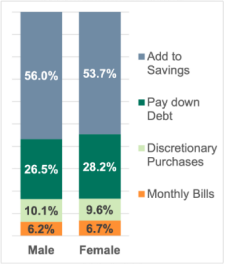
Average Percentage Allocation/Spending Priorities by Gender

Bottom Line: These research findings indicate that men tend to allocate more of their “windfall” to savings and discretionary spending, while women are more inclined to prioritize bill payments and debt reduction. This difference is likely the result of gender pay gaps, which is confirmed by comparing allocation patterns based on household income. These gender differences highlight the challenge employers and service providers face in designing effective financial solutions, products, and financial wellness programs.

Please see our latest Guest Column in the Journal of Retirement, which provides additional details surrounding Phase One of this analysis.

What do windfalls tell us about personal financial wellness? Posted By RRC, Wednesday, September 13, 2023

This is Part One of a series on financial wellness decision-making.

Background: As more employers and service providers seek to support workers on their financial wellness journeys, the RRC launched “Examining Employees’ Perceptions on Their Next Best Dollar” to better understand how financial knowledge and engagement can influence decision-making to lead to better financial outcomes for workers.

The RRC fielded an in-depth employee survey in February 2023 to 2,500 active workers that assessed their financial wellness and various related topics. Survey respondents also participated in a simulation exercise, where they were asked to spend a financial windfall commensurate to one month’s household wages. They were asked to allocate these dollars across options including consumption, savings, and debt repayment.

Findings: This simulation found that more than half of the windfall was allocated to savings, which included general savings, retirement, or other savings buckets. Debt repayment was prioritized second, with just over 27% of dollars going to credit card, mortgage, other debt, or student loans.

Average Percentage of Allocation/Spending Priorities

Detailed Average Allocation

*Other averaged 0.8%

Bottom Line: While these findings are simulated, they show that respondents are most likely to save instead of spending or paying down debt, which is a positive finding for the DC industry. Close attention should be given to paying down current monthly expenses and credit card debt, which rank almost the same in percentage as general, retirement and emergency savings. However, there is a notable competing priority in the types of savings accounts, where emergency savings and retirement savings were prioritized nearly equally. This difference could be attributed to workers’ life stage or perceived financial wellness, which will be discussed later in this series.

Subsequent Research Minutes will review nuances by gender, variable influences on decision making, and explore other advanced analysis that was performed on this data set. Please see our latest Guest Column in the Journal of Retirement, which provides additional details surrounding Phase One of this analysis.

Exploring the Evolution of Defaults and Emerging Solutions Posted By RRC, Wednesday, August 30, 2023

Background: In a recently published report, “Choice and Evolution in Defaults,” a working group from the DCIIA Investment Policy & Design Committee noted four key themes that guide both the optimal choice of a default today, and their future evolution:

1. Participant objectives and outcomes through accumulation and decumulation phases

2. Ease of use for participants

3. Personalization at the plan and individual level

4. Cost under continued downward pressure

Using these themes, the report reviews the current QDIA landscape to review changing participant objectives for traditional solution types as well as emerging QDIA options. An Action Kit offers related questions for consideration by plan sponsors, advisors, and other service providers.

Findings: Traditional QDIAs (TDFs, plan-level cTDFs, managed accounts) favor accumulation and managed investing with limited participant engagement and low-cost options. Yet, these solutions generally have lower levels of personalization due to few data elements needed to operate. The traditional QDIAs commonly do not factor in participant-populated data, including outside assets, risk preferences, expenses, and more.

However, with more employers wanting to keep participants in-plan after

retirement/termination, plans are evolving to serve as retirement income sources rather than solely focusing on retirement savings. In response, emerging default options aim to bridge that gap.

Emerging QDIA options (hybrid/dynamic, TDFs with retirement income component, personalized TDFs) favor managed investing and benefit spending to allow greater participant customization. Yet, there is limited record of adoption and utilization of these solutions due to higher costs and a higher need for participant engagement to provide additional data elements, including annuity preferences, health risks, non-traditional investments, and more.

Bottom Line: As the fundamental purposes of DC plans continue to evolve, default solutions are also evolving. This may be a good time for plan sponsors and service providers to ask key questions such as:

How important is it for the QDIA to focus on: accumulation? Managed investing? Managed spending/retirement income/benefit payments?

Is the current QDIA being used appropriately by participants? How retirement ready are participants?

What does our baseline glidepath look like, in terms of overall conservativeness / aggressiveness and shape, compared with TDF industry consensus and dispersion?

How much, and in what ways, does our participant(s) differ from typical in terms of plan demographics, investment views, and other factors?

The full report is available here.

RRC members are welcome to reach out about being a future guest contributor to the Research Minute or request coverage on a specific topic – get involved here.

Subscribe to Research Minute

With 2.3x over the average industry open rate, the Research Minute serves to provide timely, quick-read insights that also feature RRC Members as Guest Contributors. The “Research Minute” brings a series of brief, thought-provoking retirement research and behavioral economics ideas.

By clicking Subscribe you're confirming that you agree with our Terms and Conditions. Insights shared by guest contributors are their own and do not represent the views of DCIIA or the RRC. The opinions voiced in this material are for general information only and are not intended to provide specific advice or recommendations for any individual.
Thank you! Your submission has been received!
Oops! Something went wrong while submitting the form.

Stay Informed with DCIIA

Get the latest news, research, and event updates delivered to your inbox.

By clicking Subscribe you're confirming that you agree with our Privacy Policy
Thank you! Your submission has been received!
Oops! Something went wrong while submitting the form.