Rethinking Private Equity on the Glidepath: Why Mid-Career Allocation Matters
Guest Contributors: Drew Carrington, Managing Director, iCapital; Timothy McDonald, Assistant Vice President, iCapital
Target date funds (TDFs) provide a scalable framework to evaluate long-term outcome benefits of private equity within diversified portfolios. A common assumption is that private equity exposure should be frontloaded in the participant lifecycle and decline over time, mirroring public equity allocations. However, that assumption changes when considering participant behavior: older participants save more, have larger account balances, and change jobs less frequently than their younger counterparts.
Per Morningstar’s Target-Date Fund Landscape report of 2026, as of 2024, roughly $4 trillion in defined contribution (DC) assets sits in TDFs, making them the primary retirement vehicle for nearly half of 401(k) assets today [1]. This scale underscores the significance of glidepath design; small allocation changes can meaningfully impact retirement outcomes across millions of participants.
The DCALTA and the Institute for Private Capital’s study, “Why Defined Contribution Plans Need Private Investments,” finds that incorporating private equity into professionally managed portfolios, like TDFs, may improve participant outcomes through higher returns and diversification[2]. In a simulated 2005 target date fund, adding buyout funds increased annual return from 8.29% to 8.37% while reducing standard deviation from 9.89% to 8.50%, resulting in better risk-adjusted outcomes.
Finally, per Vanguard’s “How America Saves,” mid- to late-career workers tend to have higher balances and higher savings rates, meaning any diversification and return enhancement benefits from private equity could be applied to a larger pool of assets[3]. Paired with job tenure data from the Bureau of Labor Statistics, we can conclude that concentrating private equity in the middle to later stages of the glidepath may better position participants to capture private equity’s intended benefits.
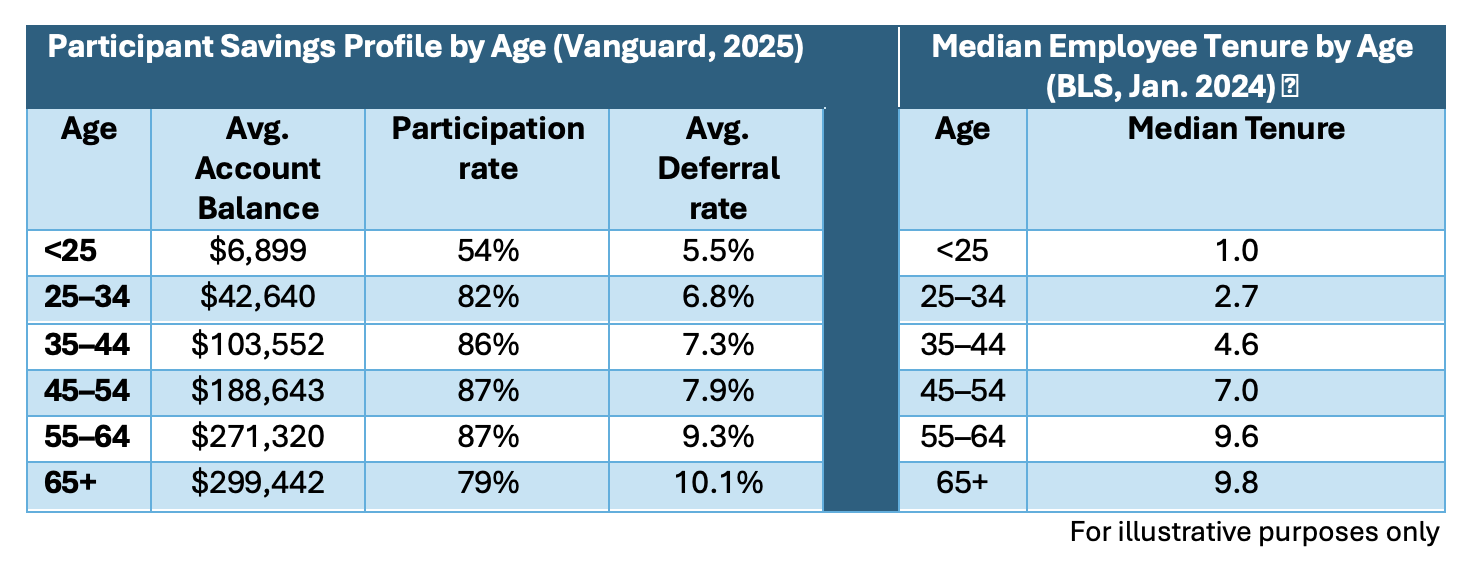
Taken together, these dynamics suggest the most effective approach is likely not a glidepath that begins at maximum private equity exposure and declines from there. Rather, it starts with a modest allocation in the early career years, ramps up as balances and average tenures grow, peaks roughly 10 to 15 years from retirement, and then tapers as participants approach and enter retirement, when liquidity needs rise again.
---
Insights shared by guest contributors are their own and do not represent the views of DCIIA or the RRC. The opinions voiced in this material are for general information only and are not intended to provide specific advice or recommendations for any individual.
Sources:
[1] Morningstar, 2026. Target-Date Fund Landscape (2026).
[2] DCALTA & the Institute for Private Capital. (October 2019). Why Defined Contribution Plans Need Private Investments.
[3] Vanguard, 2025. How America Saves 2025.