How have core menus evolved over the last decade?
Guest Contributors:
David Blanchett, Head of Retirement Research at Prudential and Portfolio Manager, PGIM; Spencer Look, Associate Director of Retirement Studies, Morningstar Center for Retirement and Policy Studies
Background:
In a recently released piece of research through the DCIIA Retirement Research Center, we explored how core menus for 401(k) plans have changed over the last decade, leveraging plan investment data from filing years 2013 to 2023. We include some key findings in this piece.
Findings:
TDFs are taking over: Target date funds (TDFs) continue to capture an increasing portion of plan assets. The long-term implications of this on the core menu are unclear. In the future, total assets in core menus could remain flat, or even achieve net positive growth if DC plans continue to gather assets—and especially if other default investment structures that build portfolios leveraging the core menu (like managed accounts) continue to gain traction.
Are core menus on autopilot? Changes in the size and composition of core menus have been relatively muted. While there have been some slight changes in menu composition, the status quo has been very much the norm over the last decade.
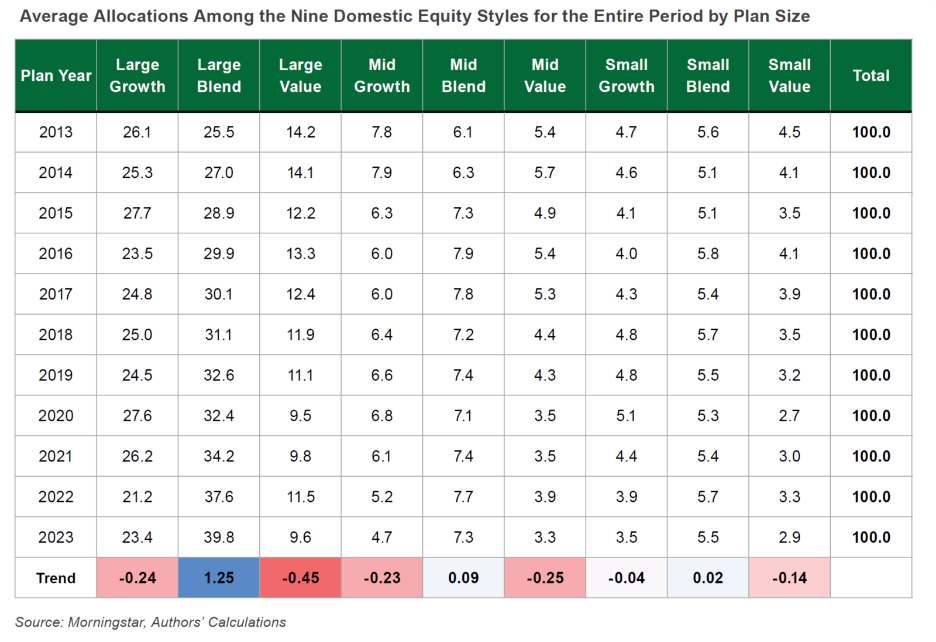
U.S. large cap equity weights are large and are getting larger: Excluding TDFs, U.S. large cap equities have the largest relative weights in core menus, and the relative share in the allocation to U.S. large cap equities has been increasing. A key factor is likely the strong recent performance of U.S. large cap stocks.
Growth trumps value: While there are generally slightly more U.S. large growth funds than U.S. large value funds in core menus, U.S. large cap growth has more than double the assets of U.S. large cap value, and the relative share of monies allocated to U.S. large cap growth has been increasing over the last decade.Fixed income is a bit of a desert: While options abound for equities, there is generally a relative lack of diversification options within fixed income in core menus, typically a single cash option and two US intermediate bond funds. Fixed income is likely to be increasingly important if more DC participants decide to stay in the plan during retirement, since older investors tend to select more conservative portfolios.
Bigger plans are more basic: Larger DC plans tend to offer fewer diversifiers than smaller plans; as such, they have a larger portion of assets in more traditional asset classes. This is a somewhat surprising finding, since larger plans would be expected to be more familiar with the potential benefits of alternatives, especially those with a defined benefit (DB) plan. In theory, larger plans should have access to more unique investment options that may not be available (or as easily accessible) for smaller plans (e.g., the private asset space).
Bottom Line:
Core menus have remained largely the same over the past decade, with only a modest increase in U.S. large cap (especially growth) and relatively limited options when it comes to fixed income. It remains to be seen how the continued growth of TDFs will influence core menus going forward.Read more about this study here.
----
Insights shared by guest contributors are their own and do not represent the views of DCIIA or the RRC. The opinions voiced in this material are for general information only and are not intended to provide specific advice or recommendations for any individual.
Disclosures:
This commentary is for informational purposes only. The information, data, analyses, and opinions presented herein do not constitute investment advice, are provided solely for informational purposes and therefore are not an offer to buy or sell a security. The performance data shown represents past performance. Past performance does not guarantee future results. Morningstar or its subsidiaries shall not be responsible for any trading decisions, damages, or other losses resulting from, or related to, the information, data, analyses or opinions or their use. DCIIA Retirement Research Center is not affiliated with the Morningstar family of companies.