This is some text inside of a div block.

How can we improve annuity literacy across diverse knowledge spectrums? (Part One)

Published on
July 10, 2024

Background: The newly released 2024 OASDI Trustee Report indicates that the projected depletion date for the trust fund remains 2033, which is only nine years away. With increasing uncertainty surrounding future Social Security retirement income, providing guaranteed lifetime income (GLI) for defined contribution (DC) plan participants has become a top priority for the retirement industry. However, understanding the benefits and potential risks associated with GLI solutions—often provided through underlying annuities—can be challenging for participants who lack sufficient knowledge and familiarity with annuity products. In this study, we investigated whether DC participants' general financial knowledge, including both their self-assessed knowledge levels and objective test scores, affects their comprehension of annuity products. Additionally, we examined whether working with a financial advisor strengthens or weakens this impact. This is part one of a two-part series.

Findings: Between March and April 2023, we surveyed over 1,300 current DC participants, on a set of nine basic and advanced annuity knowledge test questions. We performed a series of linear regression models to examine the association between general financial knowledge and annuity literacy, as well as the effect of financial advisors. Here are some of the key findings:

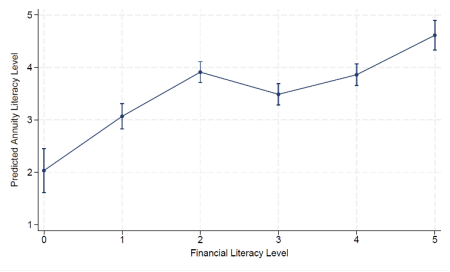
1. While the majority demonstrated a certain level of annuity knowledge, a significant proportion (14%) could not answer a single question correctly (shown in Figure 1). 2. In general, financial knowledge enhances participants' understanding of annuities,

and the limitations of using annuities to fund retirement income (shown in Figure 2).
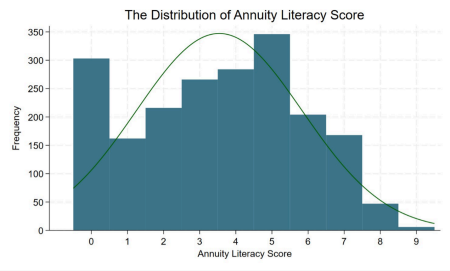
Figure 1: The Distribution of Annuity Literacy Scores for Defined Contribution Participants

Source: Korankye, T., Sun, Q., & Pandey, S. (2024). The Role of Financial Advisors in Promoting Annuity Literacy: Insights into the Moderating Effect of Financial Knowledge – working paper. Figure 2: The Predicted Annuity Literacy by Financial Literacy Level

Source: Author's calculation based on data from Korankye, T., Sun, Q., & Pandey, S. (2024). The Role of Financial Advisors in Promoting Annuity Literacy: Insights into the Moderating Effect of Financial Knowledge. The predicted result is the marginal effect of an ordinary least squared model, controlling for individuals' social demographic and financial factors.

Bottom line: A large portion of DC participants are lacking basic knowledge about annuity products. This lack of understanding regarding the underlying products of GLI solutions can lead to a lack of confidence in making critical retirement income decisions. Although this study found that higher basic financial knowledge helps improve participants' annuity literacy, other factors can influence this relationship.

In the next Research Minute, we will delve into these complexities and emphasize the need for plan sponsors to tailor their communication strategies about the benefits of guaranteed lifetime income solutions based on participants' varying levels of financial knowledge.

Insights shared by guest contributors are their own and do not represent the views of DCIIA or the RRC. The opinions voiced in this material are for general information only and are not intended to provide specific advice or recommendations for any individual.

What are DC participants' perceptions of sustainable investing? Posted By RRC, Wednesday, June 26, 2024

Background: DCIIA Retirement Research Center Private Label, AARP Public Policy Institute and Natixis Investment Managers recently completed a syndicated study of more than 3,000 defined contribution (DC) participants’ attitudes towards, awareness of, and demand for sustainable investment options in their DC plan. The results of the study along with related research were discussed in a webinar on June 25 – the replay of the webinar is available to all here.

This week’s Research Minute, part two of the series, will dive deeper into the study’s findings. As outlined in part one, three unique segments emerged from the analysis: impact investing receptive, investment fundamentals, and leadership matters. This study also explored participants’ awareness and understanding of “ESG” and “sustainable” investing, emotional reactions to these concepts, and impressions of sustainable investments’ market performance.

Findings:

1. Awareness and understanding: The terms “sustainable investing,” “ESG investing,” and “environmental, social and governance investing” have strong awareness, but not particularly strong understanding.

2. Emotional reactions: Results showed that there is very little negative energy related to the terms “sustainable investing,” “ESG investing,” and “environmental, social and governance investing.” There appears to be more positive than negative energy attached to these terms.

3. Perceptions of market performance: The perception that sustainable investments have below-market-norm performance is not widely held by DC participants. Participants’ strongest perception is there is no systemic difference in performance versus market norms. The percent “above market norms” and “below market norms” were quite small and tended to offset each other.

Bottom line: This study provides insight into participants’ views of sustainable investing, which is largely neutral. It also suggests that to unlock participant demand for sustainable investing, the industry needs to come up with better, more clear and descriptive terminology.

Find the replay and presentation deck from yesterday's related Sustainable Investment Insights webinar here.

Is there DC participant demand for sustainable investing? Posted By Warren Cormier, Wednesday, June 12, 2024

Background: Sustainable investment discussions have been largely focused on ESG factors, such as fiduciary issues, and there is much less discussion and research on defined contribution (DC) participants’ attitudes, awareness, and demand for sustainable investment options in their DC plan. To this end, DCIIA Retirement Research Private Label, AARP Public Policy Institute and Natixis recently completed a syndicated study to address this knowledge gap. Over 3,000 respondents participated in an online survey in December 2023, with data analysis, including ANOVA and multivariate analyses (segmentation, conjoint and discriminant) conducted by the DCIIA RRC Private Label.

This study measures:

Awareness and understanding of the terms “sustainable investing” and “ESG”. Demand for plan investment options that redirect funds from corporations with low ESG performance towards those actively supporting ESG initiatives.

Relative demand separated by environmental, social, and governance issues. Perceptions regarding the performance of sustainable investments.

Willingness to trade off performance to advance environmental, social and governance issues.

Messaging with the highest potential to stimulate demand.

DC participant demand segmentation.

Findings: Three unique segments emerged from the analysis: impact investing receptive, investment fundamentals, and leadership matters.

1. Impact investing receptive: 31% of the DC participant population. This segment places significantly lower weight on investment return (23%) and diversification (11%) than the other two segments. It places significantly higher weight on the impact investing decision-making factors than the other segments.

2. Investment fundamentals: 55% of the DC participant population. The largest of the three segments, this segment values traditional factors when making investment decisions, such as investment returns (39%) and diversification (33%). They place the lowest weight on the impact investing factors of the three segments. Importantly, the results of the entire survey indicate that although this segment places low priority on impact investing factors when making decisions, they are not resistant to impact investing, if it meets performance and

diversification conditions.

3. Leadership matters: 14% of the DC participant population. The smallest of the three segments, it places the greatest weight of the three segments on responsible leadership when making investment decisions (23% vs 8% for the other two segments). Their only other dominant decision-making factor is investment returns (33%). This segment could also be seen as receptive to impact investing but is more highly focused on quality of corporate leadership than environmental or social considerations.

Bottom line: This study suggests that a significant portion of the DC population, particularly the sustainable investing receptive segment, shows a considerable interest in sustainable investing, indicating untapped demand. Members of this segment are naturally receptive to this type of investment, and it seems that this group has a strong probability of investing assets in a sustainable theme in an investment menu. However,

there are barriers to reaching this segment because their interests are widely scattered across the 12 sustainable themes defined in the study, which means that many of these participants will not identify with the theme.

A second Research Minute further detailing the findings of this study is forthcoming.

Subscribe to Research Minute

With 2.3x over the average industry open rate, the Research Minute serves to provide timely, quick-read insights that also feature RRC Members as Guest Contributors. The “Research Minute” brings a series of brief, thought-provoking retirement research and behavioral economics ideas.

By clicking Subscribe you're confirming that you agree with our Terms and Conditions. Insights shared by guest contributors are their own and do not represent the views of DCIIA or the RRC. The opinions voiced in this material are for general information only and are not intended to provide specific advice or recommendations for any individual.
Thank you! Your submission has been received!
Oops! Something went wrong while submitting the form.

Stay Informed with DCIIA

Get the latest news, research, and event updates delivered to your inbox.

By clicking Subscribe you're confirming that you agree with our Privacy Policy
Thank you! Your submission has been received!
Oops! Something went wrong while submitting the form.