How are plans balancing simplicity and choice with investment menus?
Guest Contributor: Fidelity Workplace Thought Leadership
Background:
For years, plan sponsors have balanced two competing priorities with investment menus: reducing complexity while providing participants with meaningful choice. Traditionally, that debate centered on the number of investment options offered. But as participant needs, preferences, and retirement journeys have become more varied, the way plans deliver choice may be changing as well.
In Fidelity’s Data-backed considerations for defined contribution plan lineups, analysis of more than 26,000 401(k) plans examines how investment menus are evolving and how plan sponsors are delivering personalization, diversification, and participant support through their menu, as well as a broader set of plan features. The report provides data, benchmarks, and insights to help plan decision-makers design the right investment menu that best aligns with the needs of their workforce.
Findings:
Investment menus have become somewhat more streamlined over the past decade, with the median 401(k) plan offering 20 investment options in 2025, down from 22 in 2015. Yet regardless of size, most lineups continue to be built around a common set of core building blocks, giving sponsors flexibility to tailor menus to participant needs while benchmarking against peers.
Participant behavior also highlights the importance of thoughtful plan design and ongoing education. Fidelity’s research found that DIY investors hold an average of just 4.3 investments, while 61% of DIY portfolios are more equity-heavy than Fidelity’s age-based glide path would suggest. Together, these findings underscore the ongoing need for participant education around diversification and professionally managed solutions.
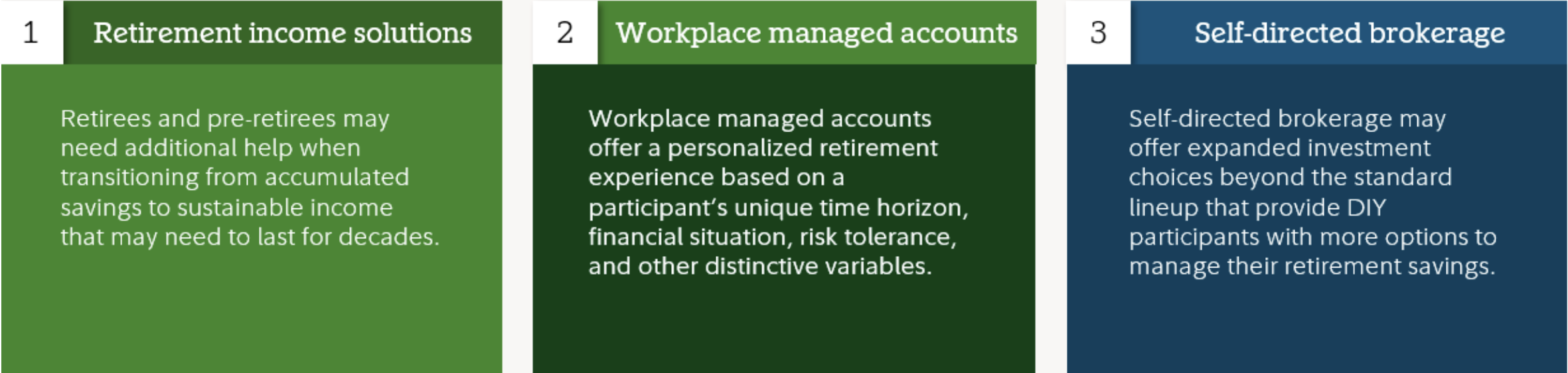
Beyond the core investment lineup, many plan sponsors are expanding the ways participants can access choice. More plans are offering workplace managed accounts, retirement income solutions, and self-directed brokerage (Figure 1). Together, these features provide participants with additional opportunities for personalization, guidance, and/or support while enabling plan sponsors to design lineups that meet the unique needs of their workforce.
Bottom Line:
There is no universally optimal investment lineup. As participant demographics, preferences, and retirement needs continue to change, plan sponsors face important decisions about how to evolve their investment menus. By evaluating their unique participant needs, benchmarking against peers, and considering the broad range of solutions available, plan sponsors can design investment lineups that balance simplicity and choice while supporting participant outcomes and plan objectives.
---
Insights shared by guest contributors are their own and do not represent the views of DCIIA or the RRC. The opinions voiced in this material are for general information only and are not intended to provide specific advice or recommendations for any individual.