Does financial advice actually pay off, and is it ever too late to benefit?
Guest Contributor: Surya Kolluri, Head of TIAA Institute & Catherine Reilly, Applied Research and Activation, TIAA Institute
Background:
The TIAA Institute partnered with Edge Research to survey 1,864 nationally representative U.S. adults ages 18–79 in October 2025. The survey used matched pairs controlling for income, age and gender to compare advised and non-advised individuals and to isolate as much as possible the influence of advice from other factors that could drive differences in outcomes. Findings were supplemented with economic modeling of three hypothetical personas to illustrate the value of advice in basis points.
Findings:
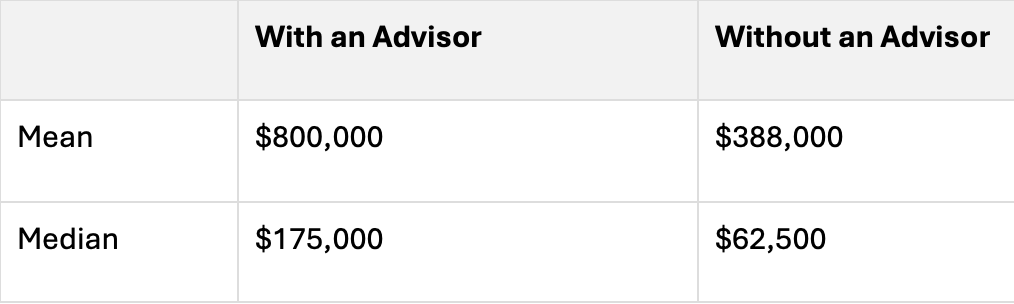
Advised individuals consistently demonstrate stronger financial outcomes than their non-advised peers. Average household net worth is more than double ($800,000 vs. $388,000), and this gap holds across the wealth spectrum, with median net worth of $175,000 for advised households compared to just $62,500 for non-advised households. Advised individuals also save more consistently (92% vs. 75%) and report 14 to 19 percentage point higher financial confidence across every dimension measured. Because individuals self-select into advisory relationships, the survey cannot definitively attribute these differences solely to the advisor; some of the gap may reflect pre-existing habits or characteristics among those who seek advice.
Mean and Median Household Net Worth by Advisory Status
Source: TIAA Institute
Separately, economic modeling of three hypothetical personas at different career stages suggests advice can deliver value equivalent to 140 to 240 basis points in additional annual returns, achieved purely through better asset allocation, tax-efficient strategies, and optimized contributions, without requiring higher savings rates. Notably, the modeling also suggests advice sought even just before retirement can still boost sustainable retirement spending by 10% or more.
Bottom Line:
Many Americans forgo advice due to misconceptions—believing they lack sufficient assets (47%), that their situation is too simple (42%), or that it's not worth the cost (44%)—rather than distrust of advisors (only 16% cite this). The data suggests these barriers are largely unfounded: value exists across all income levels and life stages, and even late engagement can meaningfully improve financial security. For institutions and advisors, the opportunity lies in correcting these misconceptions and expanding access, particularly for underserved groups such as women and older adults who underestimate the benefits available to them.
---
Insights shared by guest contributors are their own and do not represent the views of DCIIA or the RRC. The opinions voiced in this material are for general information only and are not intended to provide specific advice or recommendations for any individual.