Do employees expect and trust their employer to support their financial wellness needs?
This Research Minute is the first in a series related to financial wellness.
Background:
Financial wellness programs remain a focus across the retirement plan industry, particularly as awareness of specific employee needs have emerged and the marketplace has responded with products and solutions.
Earlier this year, the RRC fielded an in-depth employee survey of 2,500 workers that assessed their financial wellness and a variety of related topics. An additional short employer survey was deployed mid-year to understand financial program offerings and employer perspectives related to employee support.
Findings:
Employers believe that they should play a fundamental role in supporting their employees’ financial wellness, with 96% of employers agreeing with this statement, including half (50%) who strongly agree with this sentiment.
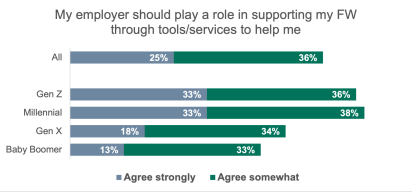
Many employees somewhat agree, with lower overall rates as seen in the table below. Also, employee perspectives varied by generation, with Millennials and Gen Zers agreeing the most, Gen Xers and Boomers were less in agreement.
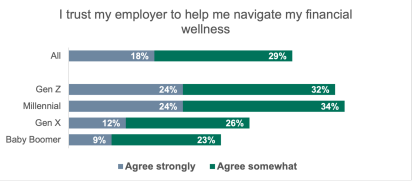
Trust was also explored given that the concept of trust is foundational in encouraging employee engagement and utilization of financial wellness programs. Across the employer survey, 89% believed their employees trust them to help navigate their financial wellness. However, only 47% of employees share this perspective (see chart below). This lower level of trust was particularly evident with Baby Boomers.
Bottom Line:
This survey explored employer and employee perspectives on the role an employer plays in administering workplace financial wellness programs and level of trust that employees have in this process. There are marked differences between generations' expectations of and levels of trust in their employer. It seems that younger generations are more open to utilizing workplace financial wellness programs, which suggests further exploration is warranted both of the reasons why as well as potential solutions targeting these specific segments.