Can harnessing AI for the DC plan participant improve retirement readiness?
Background:
Artificial intelligence’s (AI’s) sweeping influence today is likened to that of the Industrial Revolution, but this time, the changes are happening even faster — transforming how we live, work, and invest. With AI quickly gaining ground in the areas of customer service, administration, and financial planning, we think defined contribution (DC) retirement plans and plan sponsors are ideally suited to harness the technology. Our research suggests that plan participants may be ready for it, too.
Findings:
Plan participants’ overall appreciation for AI is somewhat mixed. In AllianceBernstein’s 2025 Inside the Minds of Plan Participants survey, 38% expressed positive feelings about it, 36% were neutral, and 26% negative.
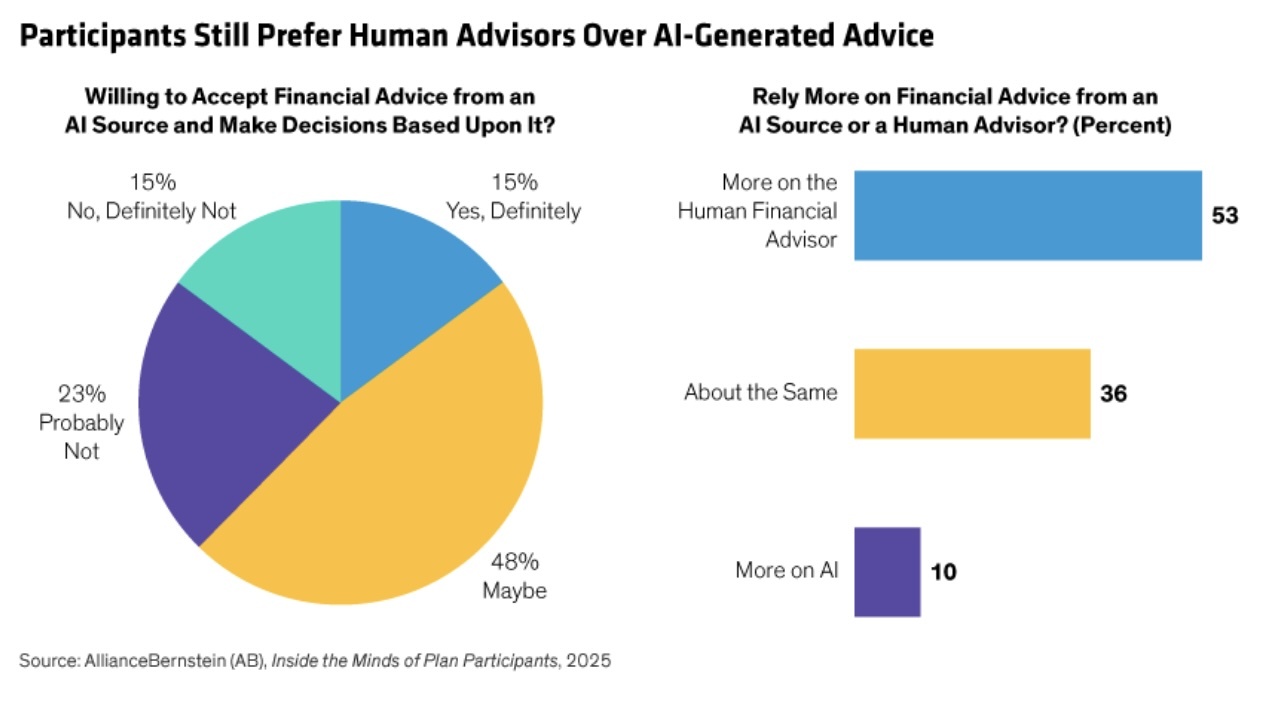
A combined 63% of respondents said they were at least open to making decisions based on AI-generated financial advice, including 15% who were very favorable, while another 15% were flat-out opposed. Asked if they favored advice from an AI source or a real person, human advisors were preferred by 53% of respondents, while 36% were split and 10% (mostly younger participants) skewed sharply toward AI.
Human or not, sage financial advice is needed now more than ever. Yet, 65% of survey respondents said they don’t use a credentialed financial advisor to keep them on the right path. Younger participants frequently turn to social media outlets for financial education, but whether these “finfluencers” are trusted sources of advice is questionable, according to our survey.
As fiduciaries, plan sponsors are cautious about dispensing individual financial advice. But AI can play a powerful role in boosting retirement plan engagement by making the experience more tailored, accessible, and interactive. It can personalize communications, forecast savings needs, and simplify financial guidance — making it easier for participants to understand and act on their retirement goals. It can also enhance customer support and provide valuable insights at scale — especially for those who feel they don’t have access to, or aren’t “qualified” for, a financial advisor.
Bottom Line:
AI workplace adoption can take time to gel among employees. We consider AI as more of a complement to than a replacement for humans, and like-minded plan sponsors are finding creative ways to foster that idea. AI can’t do it all, however, so we think plan sponsors should turn to systems that provide higher-level support from a live expert when participants need it.
Like every groundbreaking technology, AI is a game changer. It’s already transforming plan sponsor capabilities and the resources available to participants. If plan sponsors haven’t started thinking carefully about AI, now is a great time to begin.
----
Insights shared by guest contributors are their own and do not represent the views of DCIIA or the RRC. The opinions voiced in this material are for general information only and are not intended to provide specific advice or recommendations for any individual.